The Complete Guide to Weight Management in Singapore: From Lifestyle to Surgery


Clinician's Perspective:
• In Singapore, it is estimated that 12.7% of the population has a BMI of 30 or higher, a significant 22.8% of residents fall into the high-risk category (BMI ≥27.5) due to the higher risk of cardiovascular disease in Asian populations.
• Healthy diet is the foundation of successful weight management. Typically, a consistent daily caloric deficit of around 500 kcal, supported by a multidisciplinary team including dietitians and psychologists, is required for weight loss.
• Pharmacotherapy: approved medications like Phentermine and Naltrexone–Bupropion offer weight loss ranging from 3% to 5.4%, while newer agents like Semaglutide and Tirzepatide may induce 15 to 20% weight loss.
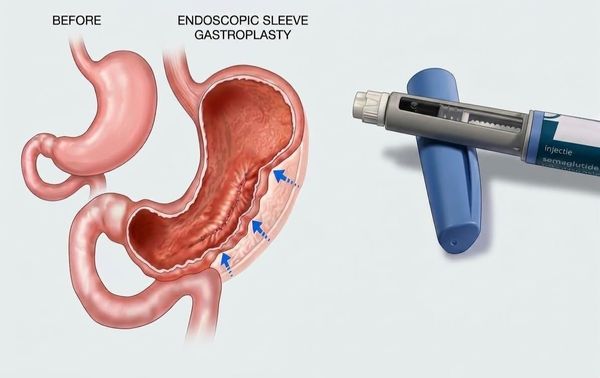
• Non-Surgical Innovation: Endoscopic Bariatric Therapies (EBTs), such as the Endoscopic Sleeve Gastroplasty (a non-surgical procedure that sutures the stomach from the inside), have shown weight loss of up to 20% after one year.
• Metabolic–Bariatric Surgery remains the most effective long-term treatment, with patients losing an average of 25% to 30% of their total body weight after 12 months.
• Chronic Disease Remission: Data reveals that 55.9% of patients with Type 2 Diabetes achieved complete remission (blood sugar levels returning to normal without medication) one year after bariatric surgery.
Integrated Weight Management: A Tiered Approach
The goal is a lifelong, multidisciplinary weight management strategy that views obesity as a chronic, relapsing disease rather than an acute condition.
Obesity is no longer viewed as a simple failure of willpower, but as a complex disorder of the energy balance (the body’s internal system for balancing energy intake and expenditure).
In Singapore, the medical landscape has shifted toward a tiered approach that prioritizes long-term "Healthspan" (the years lived in good health) by addressing Adiposity (excessive fat accumulation) before it leads to chronic complications.
The Foundation: Lifestyle and Behavioral Shifts
Lifestyle modification remains the cornerstone of all treatment. However, the data suggests that for many, caloric restriction alone is difficult to sustain because the body undergoes "metabolic adaptation," where hunger hormones increase as weight drops.
Very-Low-Calorie Diets (VLCDs), which provide fewer than 1200 kcal per day through nutritionally complete meal replacements, have been shown to induce significant weight loss and even Type 2 Diabetes remission in primary care settings.
The Middle Ground: Pharmacotherapy
For those who do not achieve sufficient results through lifestyle changes, Pharmacotherapy (the use of medicine to treat disease) may be useful.
In Singapore, several medications are approved:
- Phentermine: An appetite suppressant for short-term use.
- Orlistat: A lipase inhibitor (a drug that prevents the absorption of dietary fats) which can cause Steatorrhoea (oily stools) if fat intake is too high.
- Natrexone-bupropion: A combination oral medication that targets the brain’s reward and hunger centers to reduce food cravings and suppress appetite.
- GLP-1 Receptor Agonists: Such as Semaglutide, which mimics gut hormone to help patients feel full after eating.
Endoscopic Bariatric Therapy
A newer frontier in Singapore is Endoscopic Bariatric Therapy (EBT). These weight management procedures, such as Endoscopic Sleeve Gastroplasty (ESG), involve a doctor using an endoscope to suture the stomach lumen (the interior space of the stomach), reducing its volume by approximately 75% without any external incisions. Singapore data shows this is a safe, effective middle-ground for patients with a BMI over 27.5 who are not candidates for major surgery.
Metabolic–Bariatric Surgery
Metabolic–Bariatric Surgery (MBS) remains the most durable intervention for severe obesity.
Common procedures in Singapore include the Laparoscopic Sleeve Gastrectomy (removing a large portion of the stomach to create a narrow tube) and the Roux-en-Y Gastric Bypass (rerouting the digestive system to bypass part of the stomach and small intestine).
These surgeries do more than just "shrink the stomach." They fundamentally alter the gut microbiome and bile acid metabolism, which resets the body’s "set point" for weight. For example, for patients living with diabetes, metabolic bariatric surgery has been proven to extend life expectancy significantly more effectively than traditional medication-only treatment plans.
While surgical risks exist, such as leaks or nutritional deficiencies, significant technical advancements and the standardization of surgical protocols have made these complications increasingly rare.
Bariatric Surgery is the standard weight management approach for those at high metabolic risk.
The "One-Size-Fits-All" Myth
The Singaporean medical community is moving away from a uniform approach. Treatment is now individualized based on the patient's specific metabolic profile. For instance, if a patient experiences weight regain after surgery, clinicians may perform endoscopic suturing or introduce secondary pharmacotherapy or even revisional surgery to stabilize the energy homeostasis system.
Importantly, partnering with an experienced weight management specialist is often the most effective way to navigate the complexities of your metabolic health journey.
Evidence Strength: This landscape review synthesizes data from multiple high-quality randomized controlled trials and local cohort studies, providing a highly reliable overview of current medical standards. Final Rating: ★★★★☆
Source: Read the full study