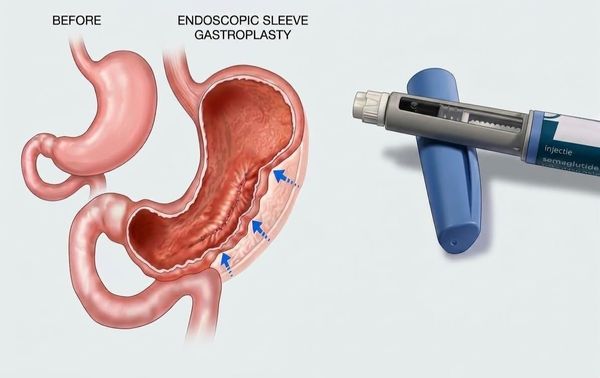
What Is Semaglutide And How Effective Is It?


Clinician's Perspective:
• Semaglutide is a GLP-1 (Glucagon-like Peptide-1) receptor agonist that mimics a natural hormone to regulate appetite and improve insulin secretion, making it a cornerstone therapy for both Type 2 Diabetes and chronic weight management.
• Weight Reduction: Participants using 2.4 mg of Semaglutide lost an average of 12.3 kg (approximately 12.1% of their total body weight) over 68 to 104 weeks.
• One-third of patients respond to Semaglutide very well, so called "super-responders"; losing 20% or more of their initial body weight.
• Cardiometabolic Improvements: Beyond weight, the data revealed a mean reduction in Systolic Blood Pressure (the pressure in your arteries when your heart beats) of 4.8 mm Hg and a 9.2 cm decrease in waist circumference, indicating a reduction in visceral fat and central obesity.
• Gastrointestinal Profile: While 77.2% of users reported Gastrointestinal (digestive system) side effects like nausea or diarrhoea, the majority of these events were transient (temporary) and occurred primarily during the dose-escalation phase.
• Sustainability Note: The analysis highlighted that weight regain is a significant risk once the medication is withdrawn, with data suggesting participants may regain a substantial portion of lost weight if treatment is not maintained.
Semaglutide is a GLP-1 (Glucagon-like Peptide-1) receptor agonist that mimics a natural hormone to regulate appetite and improve insulin secretion, making it a cornerstone therapy for both Type 2 Diabetes and chronic weight management. The key trials demonstrating its effectiveness are called the STEP trials.
The Magnitude of Weight Loss
When compared to placebo (a dummy injection) who lost roughly 3% of their weight through diet and exercise, those on Semaglutide 2.4 mg weekly dose achieved a weighted mean difference of -12.1%. In absolute terms, this translated to a 12.3 kg reduction.
The data reveals that 85.8% of participants reached the 5% weight loss threshold, a benchmark often cited by clinicians as the point where metabolic health begins to improve significantly. Furthermore, the likelihood of achieving a 20% reduction in body weight was 15 times higher for the Semaglutide group than for the placebo group.
Vascular and Metabolic Benefits
Obesity is often accompanied by hypertension (high blood pressure) and increased visceral adiposity (fat stored around internal organs). The researchers observed that Semaglutide modified these biomarkers. Systolic Blood Pressure dropped by an average of 4.8 mm Hg, and Diastolic Blood Pressure (the pressure in your arteries when your heart rests between beats) decreased by 2.5 mm Hg. Additionally, the average waist circumference—a key indicator of metabolic syndrome—shrank by 9.2 cm more than the placebo group. Furthermore, Semaglutide leads to improvement in heart health as well.
Safety and Tolerability
The pharmacological profile of Semaglutide includes a high frequency of Gastrointestinal (GI) adverse events. Nausea, diarrhea, and vomiting were reported by 77.2% of the active treatment group. However, the data suggests these are primarily "onboarding" issues. Most events were mild-to-moderate and occurred during the 16-week dose-escalation period (the timeframe where the dose is gradually increased to reach the 2.4 mg maintenance level). Only 4% of participants discontinued the drug specifically due to GI distress, suggesting that for the vast majority, the side effects are manageable. Other known side effects include the risk of developing gallstones and pancreatitis. Sporadic cases of Non-Arteritic Ischemic Optical Neuropathy (NAION) has been reported, however, it remains inconclusive as to whether Semaglutide is truly associated with NAION.
The Challenge of Maintenance
While the efficacy during the treatment period is robust, the researchers highlighted the "rebound effect." Data from trial extensions indicated that participants who withdrew from the medication regained approximately two-thirds of their lost weight within one year. This suggests that the physiological changes induced by the medication—such as suppressed appetite and delayed gastric emptying (the slowing of food leaving the stomach)—may require long-term administration to sustain the new weight set-point.
Curious about your metabolic journey? Check out our interactive educational tool to estimate your projected weight loss.
Evidence Strength: This meta-analysis of high-quality Randomized Controlled Trials (RCTs) demonstrates a very large magnitude of effect with low risk of bias, though the total number of included trials is small. Final Rating: ★★★★☆
Source: Read the full study