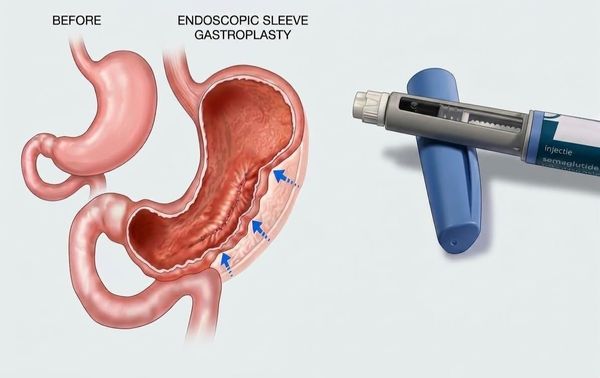
What is Tirzepatide And How Effective Is It?


Clinician's Perspective:
• Tirzepatide is a medication that targets two distinct hormone receptors: the Glucagon-like Peptide-1 (GLP-1) and the Glucose-dependent Insulinotropic Polypeptide (GIP). As a result, the stomach emptying is slowed down and appetite is reduced.
• Dose-Dependent Weight Loss: Across clinical trials lasting 72 weeks, participants achieved total body weight reductions ranging from 5% to 20.9%, depending on the dosage administered.
• Glycemic Regulation: Tirzepatide significantly lowered HbA1c (a marker of three-month average blood sugar levels) by up to 28.2 mmol/mol at the highest dose of 15 mg.
• Lipid Profile Enhancement: The data indicates a notable reduction in Low-Density Lipoprotein Cholesterol (LDL, or "bad" cholesterol) and triglycerides, while simultaneously increasing High-Density Lipoprotein Cholesterol (HDL, or "good" cholesterol).
• Appetite and Satiety Modulation: Clinical assessments using Visual Analog Scales (tools used to measure subjective feelings) revealed a significant reduction in appetite and a sharp increase in the feeling of fullness.
• Fat Mass Reduction: Preliminary findings suggest that the weight lost during treatment is primarily derived from a reduction in Adiposity (body fat mass) rather than lean tissue.
• Gastrointestinal Management: While side effects like nausea are common, they are typically managed through dose escalation (gradually increasing the medication over several weeks), with only 4% to 10% of participants discontinuing treatment due to adverse events. Interestingly, GIP action helps reduce nausea, hence the rate of vomiting maybe less than other GLP-1 receptor agonists.
The metabolic management of Obesity and Type 2 Diabetes Mellitus (T2DM) has entered a promising new era with the emergence of "dual-agonist" therapy. Tirzepatide, a first-in-class medication that essentially "double-teams" metabolic issues. Unlike older treatments that target only one hormone, tirzepatide activates two distinct receptors in the body: Glucagon-like Peptide-1 (GLP-1) and Glucose-dependent Insulinotropic Polypeptide (GIP). By mimicking these two natural hormones, the medication helps the body regulate blood sugar and process fats more efficiently than previous single-target therapies.
Effective Weight Loss
One of the most striking findings in the review is the significant shift in weight management outcomes. In clinical trials lasting 72 weeks, participants using tirzepatide achieved a total body weight reduction of up to 20.9%—effectively losing a fifth of their starting mass. This weight loss is "dose-dependent," meaning that under medical supervision, higher concentrations generally lead to greater reductions in body fat. Crucially, the evidence suggests that the weight lost is predominantly fat mass rather than muscle. This is a vital distinction for long-term health, as it helps patients avoid sarcopenia, which is the loss of muscle strength that often accompanies aging or rapid, unmonitored weight loss.
Improvement in Diabetes Control
Beyond what is visible on the scale, the medication provides a robust defense against the complications of Type 2 Diabetes. Over a 40 to 52-week period, researchers observed that HbA1c levels—the primary "gold standard" measurement for long-term blood sugar control—dropped by as much as 28.2 mmol/mol. By stabilizing these glucose levels, the therapy reduces the constant metabolic strain on the body. Furthermore, the medication appears to improve heart health by cleaning up the "lipid profile." Trials showed a consistent decrease in triglycerides and "bad" LDL cholesterol, alongside an increase in "good" HDL cholesterol, potentially lowering the long-term risk of heart disease.
How Does It Work?
The secret to these changes lies in how the medication retrains the body’s relationship with food. Tirzepatide works by increasing "fasting satiety"—the feeling of being full even before you start a meal—while simultaneously quieting intense food cravings.
Side Effects
While the results are significant, the review acknowledges that gastrointestinal side effects, such as nausea, are the most common hurdle for new patients. To manage this, doctors use a slow "dose escalation" strategy, gradually increasing the medication to let the body adjust. This method is highly effective, with the vast majority of participants (90% to 96%) successfully completing their treatment cycles. Patients may experience injection site irritation. Furthermore, there is also increased risk of pancreatitis and gallstones.
Lifestyle Modification Is Paramount
It is important to note weight regain may occur upon stopping the medication. More long-term studies are needed to see how these benefits hold up over many years. Ultimately, successful weight management with long term results require adoption of healthy lifestyle.
Curious about your metabolic journey? Check out our interactive educational tool to estimate your projected weight loss.
Evidence Strength: This review synthesizes high-quality evidence from the SURPASS and SURMOUNT clinical trials, demonstrating a large magnitude of effect across weight loss and glycemic markers, though as a narrative review, it lacks the formal statistical pooling of a meta-analysis. Final Rating: ★★★★☆
Source: Read the full study